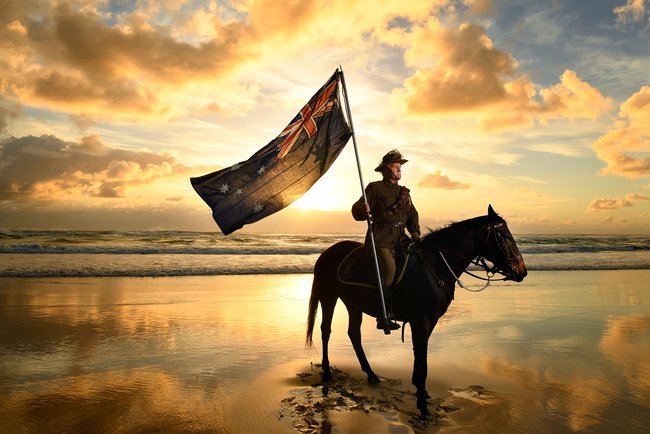

Australian New Zealand Army Corp Day
ANZAC DAY held annually on April 25th, is a national day of commemoration in Australia and New Zealand.
About Anzac Day
The significance as a day of reflection on the “spirit of ANZAC”—courage, mateship, and sacrifice—honouring those who served in wars, conflicts, and peacekeeping operations. Commemorates all who have served and died in military operations, honouring the “Anzac legend”.
Rituals
The day begins with a Dawn Service (simulating the time of the original landing) at war memorials. This is followed by commemorative marches in states, cities and towns across Australia + New Zealand. Also global locations of significance. Gallipoli being the base camp of the initial sacrifice of life event on harsh coast of Turkey.
The Landing
The ANZACs landed at Gallipoli on April 25, 1915, aiming to secure the peninsula. While marking the 1915 campaign, it now honours the more extended period with over two million Australians who have served in the Australian army corp.
Main Ceremonies
Dawn Service ~ Traditionally includes a solemn, quiet, and reflective ceremony with prayers, hymns, and the “Last Post” bugle call.
Marches ~ Ex-servicemen and women, along with descendants, march through streets in cities and towns.
Legacy ~ The day is a cornerstone of Australian national identity, reflecting on both the past and present military contributions.
The Worst of War
Remembering the real human loss in the worst of war between nations with sacrifice of good men & women. Proudly their countries with courage in the ideals of politics & paying the ultimate price in dying far from home. A war of so much loss for sol little gain, becoming an annual rememberance of war for all that its offers, an example to beware, respect, be thankful of our peaceful life.
Why Gallipoli
The French politician Aristide Briand proposed in November to attack the Ottoman Empire, but this was rejected and an attempt by the British to bribe the Ottomans to join the Entente side also failed. Later that month, Winston Churchill, First Lord of the Admiralty, proposed a naval attack on the Dardanelles, based in part on erroneous reports of Ottoman troop strength. Churchill wanted to use a large number of obsolete battleships, which could not operate against the German High Seas Fleet, in a Dardanelles operation, with a small occupation force provided by the army. It was hoped that an attack on the Ottomans would also draw Bulgaria and Greece into the war on the Entente side. On 2 January 1915, Grand Duke Nicholas of Russia appealed to Britain for assistance against the Ottomans, who were campaigning in the Caucasus. Planning began for a naval demonstration in the Dardanelles, to divert Ottoman troops from Caucasia.
The Gallipoli coast attack, was a major amphibious landing by British Empire and French forces (the Allies) on the Gallipoli Peninsula in Ottoman Turkey during World War I. The campaign was designed to break the deadlock on the Western Front by knocking the Ottoman Empire out of the war, opening a supply route to Russia, and controlling the Dardanelles Straight.
The Gallipoli campaign (1915–1916) was a disastrous World War I campaign caused by poor leadership, flawed intelligence, and underestimation of Ottoman defenses. Key mistakes included relying on inaccurate, outdated maps, landing troops on the wrong beaches, inadequate planning for, and failing to secure high ground, leading to a bloody, eight-month stalemate and over 140,000 Allied casualties.
Wiki Anzac Info
Key Aspects
The Landings of 25 April 1915, Allied forces—including the Australian and New Zealand Army Corps (ANZAC)—landed at Anzac Cove and Cape Helles. Troops encountered steep terrain and fierce resistance from Ottoman defenders.
Opposing Forces
Presented a very real campaign characterized by brutal trench warfare. The Ottoman defense was significantly bolstered by the leadership of Mustafa Kemal (later Atatürk), who commanded the 19th division and later the Anafarta sector, preventing an Allied breakout from Suvla Bay.
Stalemate + Evacuation
Neither side could gain a decisive advantage, leading to a long stalemate. The evacuation, deemed the most successful part of the operation, was completed in December 1915 and January 1916.
Casualties
The campaign caused tremendous casualties, with over 75,000 Australian and New Zealanders serving, leading to over 10,000 deaths. British forces suffered over 22,000 deaths, and French forces incurred roughly 8,000–10,000 fatalities.
Significance
While a defeat for the Allied powers, the campaign is central to the national identities of Australia and New Zealand, commemorated annually on Anzac Day. It also served as a critical, foundational battle for the emerging Turkish nation.
AUS Courage
Given the Australian population was only 5 million people in 1915, nearly 100,000 men enlisted in the Australian Imperial Force (AIF), contributing to the over 50,000 Australians who served at Gallipoli that year. Over half of these soldiers would die, most injured, wounded, all would return with undiagnosed post war stress only to reinlist to serve & sacrifice for thier country. mental of these soldiers would die Half of these me Total enlistments during WWI reached 416,809. Service numbers in 1915 varied by unit and could change if a soldier was discharged and re-enlisted. These numbers meant roughly 1 million families with 1 in 10 having a person serving in the army active in fighting a world war. However in many families had multiple members, fathers, bother, sisters involved which effected communities throughout Australia.
NZ Warriors
Approximately 2,779 New Zealanders died during the Gallipoli campaign in 1915. Total New Zealand casualties—including those killed in action, died of wounds or disease, and the estimated 8,000 wounded—represented a significant percentage of the roughly 16,000 to 17,000 Kiwis who served there. The deaths represent about a sixth of all New Zealanders who fought in the eight-month campaign, which failed to take the Turkish peninsula.
Turks Tragedy
Estimates of Turkish deaths during the Gallipoli campaign (April 1915 – January 1916) generally range between 57,000 and 87,000 soldiers.
Total Casualties, including wounded, missing, and sick, total Ottoman casualties are estimated to be around 250,000. In significant engagements, such as the 19 May 1915 counter-attack, over 3,000 Turkish soldiers were killed in a single day. The heavy death toll was due to intense, prolonged fighting, disease, and poor sanitation, with the Ottoman Empire losing a substantial portion of their workforce, including many 21 to 34-year-olds. The campaign is considered a major victory for the Ottoman Empire, but it was achieved at a tremendous cost.
ANZAC SPIRIT
Australian Military Deaths by Conflict:
First World War (1914–1921): Over 60,000–61,724 deaths.
Second World War (1939–1947): Approximately 39,658 deaths.
Korean War (1950–1953): 340 deaths.
Vietnam War (1962–1973): 521 deaths.
Other Conflicts & Operations:
Boer War (1899-1902): Over 500 deaths.
Malayan Emergency (1950-1960): 39 deaths.
Indonesian Confrontation (1962-1966): 16 deaths.
Gulf War (1990-1991): No direct combat deaths reported.
Afghanistan (2001-2014): 41 deaths.
Iraq War (2003-2011): 2 deaths.
Australian War Memorial
“We will Remember them”
“LEST WE FORGET”
anzacportal.dva.gov.au
commemoration/anzac-day
anzacspirit.com.au
nma.gov.au/defining-moments
Anzac Quotes
army.gov.au-the-ode
AZAC LEGEND LIVES
“Lest We Forget”

sunsetcoast.life – sunsetcoast.xyz